

Why Black Men and Racial Trauma Must Be Taken Seriously

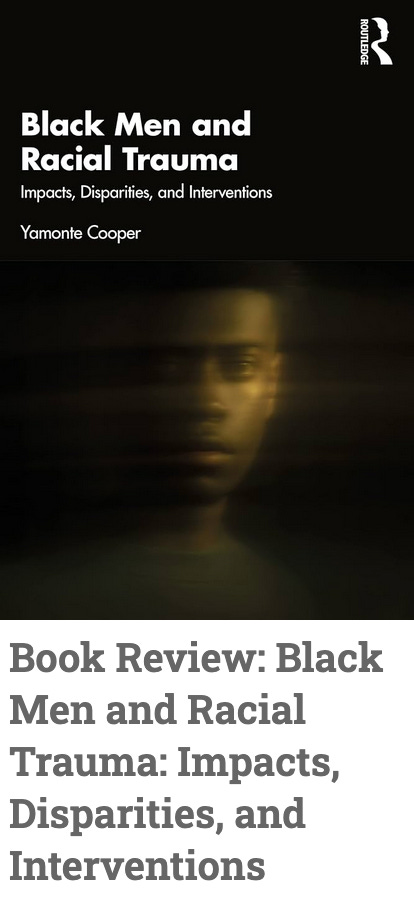
A recent review in Trauma Psychology News, the newsletter of the American Psychological Association’s Division of Trauma Psychology, offers an important reflection on Black Men and Racial Trauma: Impacts, Disparities, and Interventions. The review situates the book not simply as a clinical text, but as a necessary reframing of how trauma is defined, recognized, and treated when racism is the primary source of harm.
What stands out immediately is the reviewer’s emphasis on a core argument of the book: racism is not an occasional stressor or background variable. It is a trauma producing condition that is chronic, cumulative, and structurally embedded in American life. This framing directly challenges dominant trauma models that continue to privilege discrete events while minimizing sustained exposure to racialized threat, exclusion, and surveillance.

Racism as a Trauma System
The review highlights how the book pushes beyond individual level explanations by naming the systems that generate psychological injury. Housing policy, policing, education, labor markets, and media representation are not treated as context, but as mechanisms through which trauma is produced and maintained. According to the reviewer, the book brings these realities into clear focus, allowing clinicians to better understand the lived psychological consequences of anti-Blackness rather than defaulting to pathologizing interpretations.
This matters because when structural harm is ignored, Black men are often misdiagnosed, misunderstood, or framed as resistant to care. The review underscores that the book offers clinicians language and conceptual tools to recognize how vigilance, mistrust, emotional withdrawal, and anger can be adaptive responses to chronic racial threat rather than evidence of individual dysfunction.
Integrating Theory and Lived Experience
Trauma Psychology News also draws attention to the book’s integration of multiple frameworks into a cohesive model of racial trauma. Rather than presenting disconnected theories, the text synthesizes models that account for historical trauma, intergenerational transmission, and ongoing exposure to violence and discrimination. The reviewer notes that this integrated approach allows readers to see how past and present harms interact, particularly for Black men whose lives are shaped by both inherited vulnerability and contemporary risk.
Importantly, the review describes the book as accessible without being reductive. Theoretical depth is paired with clinical relevance, making the material usable for practitioners while remaining grounded in empirical and historical scholarship.
A Litany of Recognition
One of the most striking observations in the review is the characterization of the book as reading like a litany. Page after page, experiences described in the text are likely to be recognized by Black readers and familiar to clinicians who work closely with Black men. This sense of recognition is not incidental. It reflects the reality that many of these harms have long been known but rarely centered within mainstream trauma psychology.
The reviewer suggests that this cumulative recognition has an effect. It pushes readers beyond denial or minimization and toward acknowledgment. In trauma work, acknowledgment is not symbolic. It is a prerequisite for ethical assessment, effective intervention, and meaningful change.
Implications Beyond the Therapy Room
While the book is written with clinicians in mind, Trauma Psychology News makes clear that its implications extend far beyond psychotherapy. The review points to its relevance for researchers, educators, policymakers, and institutions responsible for shaping mental health systems. Training models, diagnostic frameworks, and evidence based practices cannot remain neutral if neutrality continues to reproduce racial harm.
The reviewer emphasizes the importance of clinician self awareness and cultural accountability, noting that failure to interrogate dominant assumptions about masculinity, danger, and pathology often leads to clinical misrecognition of Black men’s distress.
Moving the Field Forward
The review ultimately positions Black Men and Racial Trauma as a text that advances trauma psychology rather than sitting at its margins. It challenges the field to confront what has been systematically excluded from dominant models and to expand its definitions of both trauma and recovery.
As Trauma Psychology News concludes, this is a book that will continue to be read, cited, and engaged by those seeking to deepen their understanding of racial trauma and to carry this work forward in research, clinical practice, and public health.