

Reader Poll Results: Top 9 Essay Topics

🟣 Reader Poll Results: Top 9 Essay Topics
Thank you to everyone who participated in the reader poll. The poll results reveal clear patterns in what people want to see examined next.
🟣 Summary of Reader Poll Results
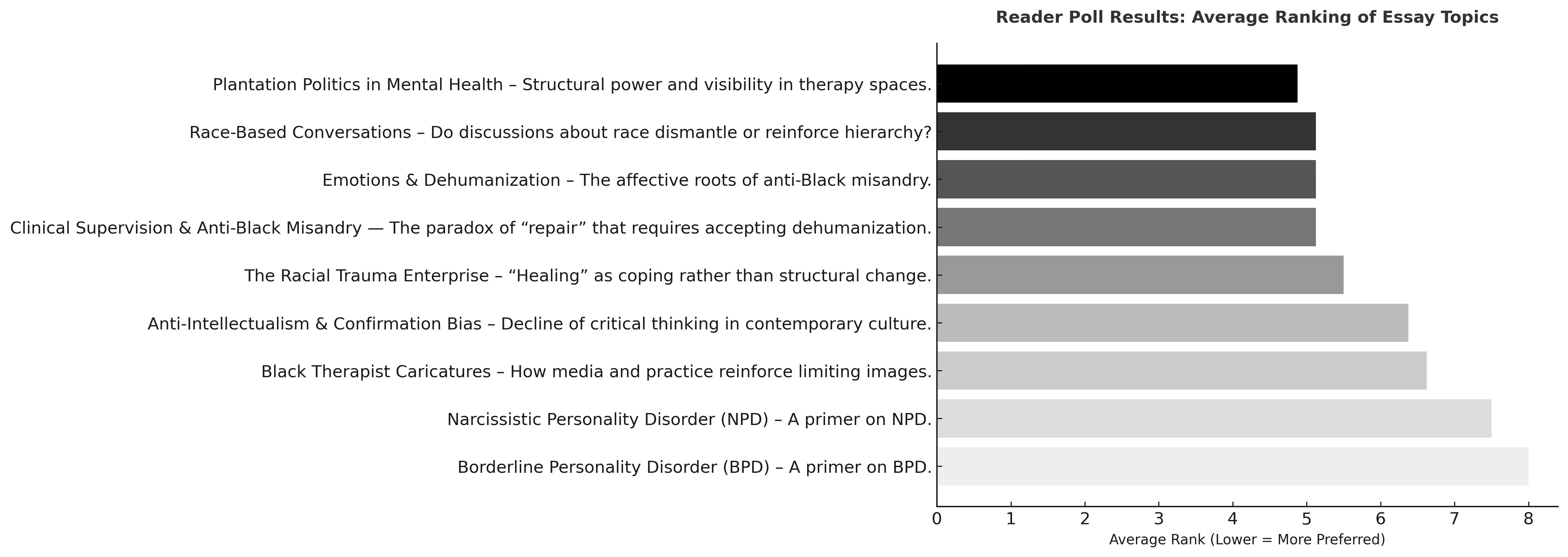
Responses reveal a clear preference for essays that explore the nexus between race, power, and psychological discourse. Topics such as Plantation Politics in the Mental Health Field, Race-Based Conversations, and Emotions & Dehumanization emerged as the most compelling to readers. The next group of interests, Clinical Supervision & Anti-Black Misandry and The Racial Trauma Enterprise, continue this focus and highlight how structural and affective dynamics shape mental health practice. By contrast, the more clinically oriented topics (NPD and BPD) ranked lower and suggest that readers are most engaged by work that connects personal experience to broader systems of meaning and dehumanization.
Figure. Reader Poll Results
Average rankings for nine essay topics, with lower scores indicating higher reader preference.
Interpretation:
The highest-ranked topics, Plantation Politics in the Mental Health Field, Race-Based Conversations, and Emotions & Dehumanization, reflect strong interest in the nexus of race, power, and psychological discourse. Mid-tier interest areas include Clinical Supervision & Anti-Black Misandry and The Racial Trauma Enterprise, both of which extend this structural focus into therapeutic and institutional contexts. Topics such as Narcissistic Personality Disorder (NPD) and Borderline Personality Disorder (BPD) ranked lower overall and suggest that readers may prioritize analyses of systemic and relational issues over clinical primers.
💬 Closing Reflection
The range of responses underscores the many ways readers are thinking about culture, psychology, and power as interconnected mechanisms. If one of these topics especially resonated with you or if there is an angle you would like to see explored further, feel free to share your reflections in the comments. Reader insights often shape how future essays unfold.