

Plantation Politics in Academia, Part III: Historical Continuity and Epistemic Control

The previous installments examined how academic institutions establish the boundaries of legitimate inquiry and how scholars, theories, and professional networks reproduce those boundaries. These processes are not recent deviations from an otherwise neutral university. They belong to a longer history in which education and knowledge production have been used to cultivate consent, regulate dissent, and determine which interpretations of Black life become institutionally acceptable.
This final installment situates contemporary academic gatekeeping within that historical continuity. It examines curricular reform, the miseducation of Black Americans, the integrationist orientation of scholarship, the institutionalization of Black Studies, and plantation politics as a system of epistemic control.
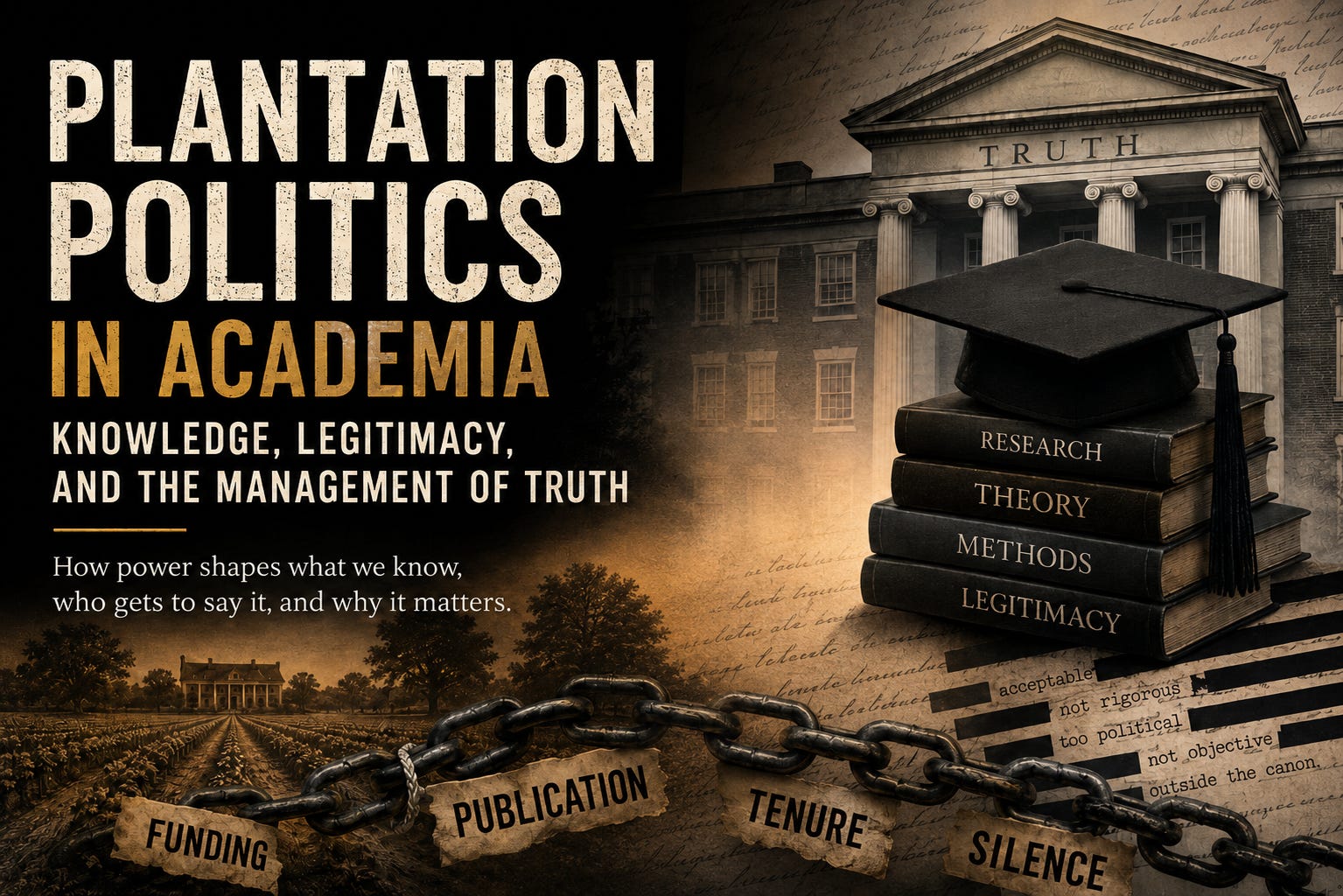
Historical Continuity
These dynamics are not new. Academic and philanthropic institutions have long shaped the boundaries of Black political thought, privileging integrationist and professionally acceptable frameworks while marginalizing structurally grounded critiques.
Spanos (1993) extends this history by tracing major educational reform movements to periods of political crisis. Curricular reforms following World War I, World War II, and the disruptions of the Vietnam era were presented as neutral efforts to restore coherence, rigor, and a shared intellectual foundation.
Yet they also worked to reestablish national consensus, contain emerging forms of knowledge, and neutralize challenges from students, Black and other racial groups, women, and anti-war movements. In this account, the university functions not simply as a site of education, but as an ideological apparatus that converts political discipline into the language of disinterested inquiry and common intellectual purpose.
Almost a century ago, Woodson (1933) described the education of Black Americans as an indoctrination-based apparatus that cultivated inferiority and trained Black people to evaluate themselves through standards developed by white Americans. Knowledge production and the intentional withholding or curation of knowledge for Black Americans have functioned as instruments of social control since slavery.
Cruse (1969/2002) similarly argued that the integrationist ethic had shaped the foundations of scholarly inquiry, with both Black and white academic rationalizations reinforcing an Anglo-American framework presented as universal.
In his account, this framework worked toward the nullification of cultural traditions indigenous to Black life while restricting the development of an intellectually independent Black Studies. He proposed that Black Studies should begin with Black history, class formation, plantation relations, institutional development, and the examination of the broader cultural apparatus rather than merely incorporating Black subject matter into existing academic structures.
Frazier’s (1962) critique of the Black intellectual class and Reed’s (1995) account of the freelance race spokesman extend this analysis to the production of Black intellectual authority. They show how Black intellectual authority can be produced through institutional recognition rather than accountability to Black constituencies.
The movement from Black Power to Black Studies further illustrates how radical political demands can be translated into academic disciplines, gaining institutional permanence while becoming subject to professional expectations and university control (Rojas, 2010).
Rojas (2010) provides a concrete example of how this translation occurred. The Ford Foundation initially viewed Black Studies as a means of promoting racial integration and later emphasized disciplinary legitimacy, research production, elite universities, and “centers of excellence.”
This shift redirected attention from undergraduate movement demands and accountability to Black communities toward professional research agendas, institutional visibility, and conformity with the norms of the university.
What has changed is not the existence of this control, but its form. It is now embedded within standardized practices of research, evaluation, and professional advancement, making it less visible and more durable.
Plantation Politics as Epistemic Control
Within academic contexts, plantation politics operates as epistemic control: the regulation of knowledge, legitimacy, and interpretation through institutional structures that reward alignment and constrain dissent (Cooper, 2024).
Across domains, the pattern is consistent. Activism absorbs dissent. Mental health reframes distress. Politics administers power. Celebrity shapes perception. Academia defines reality.
Each domain performs a distinct function, but all operate through the same logic. Intermediaries translate structural conditions into forms that can be managed without altering underlying relations of power. In academia, this translation occurs through theory, method, and professional norms that determine what can be known and how it can be known.
Among segments of the Black intelligentsia, authority, tradition, rhetorical eloquence, and professional prestige can take precedence over empirical accountability. Myths, entrenched beliefs, and socially desirable narratives are repeated until they acquire the appearance of truth.
Under plantation politics, intellectual authority depends less on whether an explanation accurately describes Black life than on whether it remains intelligible, useful, and acceptable to the institutions empowered to certify it.
In the contemporary era, one of the most durable instruments of plantation politics is knowledge production itself.
Conclusion
If plantation politics organizes how dissent is managed, how suffering is interpreted, and how power is maintained, then its most durable form may be its control over knowledge itself. What cannot be named cannot be challenged. What cannot be studied cannot be transformed.
The question is not whether inequality exists, but who is permitted to define it, explain it, and respond to it. Until that terrain shifts, plantation politics will persist in policy, culture, and the very frameworks used to understand them, stabilizing existing arrangements under the appearance of inquiry.
If science and knowledge production are not organized around the quest for truth, then what function do they serve? When institutions reward conformity, protect prestige, circulate the same ideas, and suppress evidence that threatens accepted narratives, knowledge production becomes a mechanism for reinforcing hegemony and reproducing hegemonic groups.
The central problem is that academic institutions can make particular forms of wrongness professionally useful, intellectually respectable, and extraordinarily difficult to dislodge.
This three-part essay concludes the examination of plantation politics in academia. The final essay in the broader Plantation Politics series will draw together its operation across activism, mental health, electoral politics, celebrity culture, and knowledge production.
References
Cooper, Y. (2024). Black men and racial trauma: Impacts, disparities, and interventions. Routledge.
Cruse, H. (2002). The integrationist ethic as a basis for scholarly endeavors. In W. J. Cobb (Ed.), The essential Harold Cruse: A reader (pp. 117–124). St. Martin’s Griffin. (Original work published 1969)
Frazier, E. F. (1962, February). The failure of the Negro intellectual. The Negro Digest, 26–36.
Reed, A. (1995, April 11). “What are the drums saying, Booker?”: The current crisis of the Black intellectual. The Village Voice, 31–36.
Rojas, F. (2010). From Black power to Black studies: How a radical social movement became an academic discipline. Johns Hopkins University Press.
Spanos, W. V. (1993). The end of education: Toward posthumanism. University of Minnesota Press.
Woodson, C. G. (1933). The mis-education of the Negro. Associated Publishers.