


Knowledge is not neutral. What counts as legitimate knowledge, which questions are asked, and which explanations are taken seriously are shaped by institutional power. Academic and professional spaces do not simply reflect reality. They organize it.
Universities, research institutions, and professional organizations present themselves as sites of objective inquiry, governed by evidence, rigor, and methodological transparency. Yet what appears as neutral evaluation is structured by norms of acceptability, professional incentives, and institutional priorities. These mechanisms do not operate at the margins. They define the boundaries of knowledge itself.
This first installment examines how claims of academic neutrality conceal the institutional organization of inquiry. It focuses on prestige, disciplinary gatekeeping, and scientific censorship as mechanisms that shape what can be studied, circulated, and recognized as knowledge.
The Illusion of Neutral Knowledge
Academic knowledge is often presented as the outcome of disinterested inquiry. Research questions are framed as emerging naturally from gaps in the literature, and findings are evaluated based on methodological rigor. This framing obscures a more fundamental reality: knowledge production is structured before inquiry even begins.
What is studied, how it is studied, and which interpretations are considered credible are shaped by institutional expectations. Funding bodies, journals, hiring committees, and professional networks collectively define what counts as legitimate scholarship. These structures do not simply reward quality. They reward alignment.
Prestige also influences how scholarship is evaluated. In a preregistered field experiment, Huber et al. (2022) presented reviewers with the same manuscript attributed either to a Nobel laureate, a relatively unknown early-career researcher, or no named author. Twenty-three percent recommended rejection when the Nobel laureate was named, compared with 48 percent when the paper was anonymous and 65 percent when the early-career researcher was named. More than 20 percent recommended acceptance when the Nobel laureate was identified, compared with fewer than 2 percent when the lesser-known scholar was identified.
Peer reviewers may also evaluate findings more favorably when those findings conform to their existing beliefs, theoretical orientations, or political commitments (Clark et al., 2023). These dynamics permit the same scholars and ideas to circulate repeatedly while selective and subjective judgments are presented through the language of merit, rigor, and scholarly excellence.
As a result, academic inquiry is not an open field of exploration. It is a bounded system in which certain lines of analysis are encouraged while others are implicitly or explicitly discouraged.
The Boundaries of Legitimate Inquiry
The most effective form of intellectual control is not simply censorship, but the pre-structuring of what counts as a legitimate question. Scholars quickly learn which approaches are considered rigorous and which are dismissed as ideological, reductive, or insufficiently nuanced.
Structural explanations of inequality are often treated with suspicion. Analyses that foreground power, domination, or material conditions are frequently recast as overly political or lacking complexity. In contrast, explanations that diffuse responsibility or emphasize individual, cultural, or psychological factors are more readily accepted as balanced and empirically grounded.
This is not accidental. It reflects an institutional preference for interpretations that do not fundamentally challenge existing arrangements. The range of acceptable explanations is narrowed in advance, ensuring that even critical inquiry remains contained.
Scientific Censorship and Soft Control
Clark et al. (2023) define scientific censorship as actions intended to prevent particular scientific ideas from reaching an audience for reasons other than low scientific quality. Their research agenda identifies motives that include protecting one’s reputation, protecting peer scholars, and attempting to prevent perceived harm to social groups. These motives may be framed as benevolent or prosocial, but they can still restrict inquiry and prevent evidence from challenging socially desirable beliefs.
Science is ideally distinguished by its capacity to allow evidence to supersede authority, tradition, rhetorical eloquence, and social prestige. This gives science the potential to function as a radical force, disrupting myths, inherited beliefs, and narratives that remain socially desirable despite weak empirical foundations. That potential is constrained when scholars decide in advance which questions are acceptable or which findings the public should be permitted to encounter (Clark et al., 2023).
Clark et al. distinguish between hard and soft censorship. Hard censorship is exercised through direct control over the dissemination of ideas, historically by governments and religious institutions. Soft censorship relies on social and professional punishment, including ostracism, public shaming, double standards in hiring and firing, publication retractions, denial of funding, and threats to professional standing.
Soft censorship also includes warnings from department chairs, mentors, and colleagues that pursuing a particular line of inquiry may damage a scholar’s career. Such warnings may not formally prohibit research, but they can effectively determine what is studied.
Social media campaigns can also be weaponized against scholars, while wealthy donors may threaten to withdraw financial support. Censorship may become a means of signaling allegiance, as individuals denounce others to establish their own moral standing or affirm the superiority of their intellectual group. Scholars in the social sciences are more supportive of censorship than scholars in STEM fields. These practices ultimately risk reducing public trust in research and science (Clark et al., 2023).
The demographics of academia further shape this process. In 2022, 72 percent of full-time faculty were white, including 37 percent white men and 35 percent white women. Thirteen percent were Asian, including 7 percent Asian men and 6 percent Asian women; 7 percent were Black, including 4 percent Black women and 3 percent Black men; and 6 percent were Hispanic, including 3 percent Hispanic women and 3 percent Hispanic men (National Center for Education Statistics, 2024).
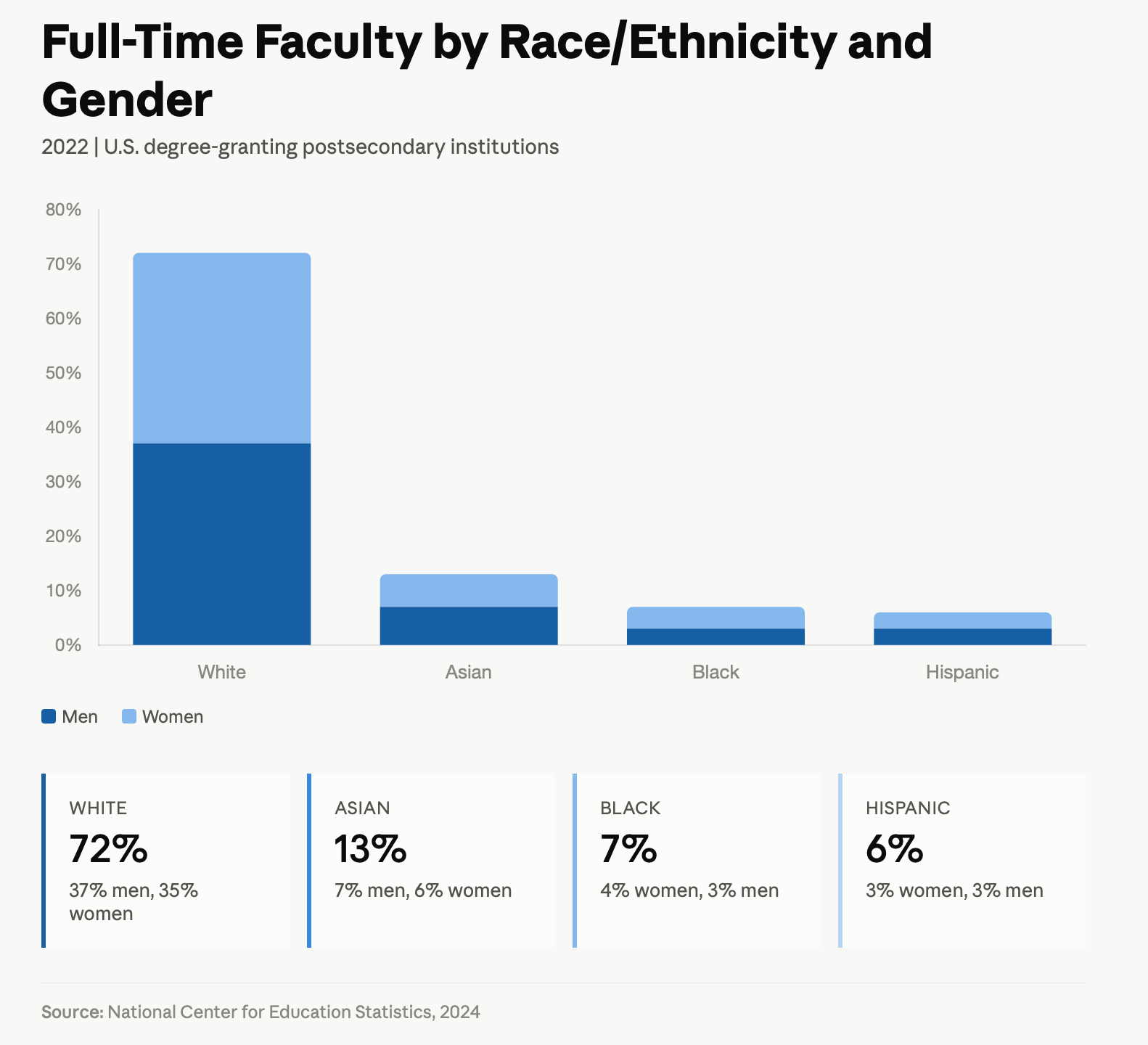
Demographic concentration does not by itself establish intellectual uniformity. However, majority groups inevitably influence which topics, populations, and perspectives are understood as important, timely, fundable, or worthy of publication. This can contribute to the epistemic suppression of Black scholars, particularly those whose work does not reproduce palatable interpretations or reinforce established Western frameworks.
Conclusion
Academic control does not require a formal prohibition against inquiry. It can operate through prestige, funding, peer review, professional warnings, and apparently neutral standards of relevance or rigor. These mechanisms shape knowledge before a study is conducted and determine how the resulting evidence will be received.
The problem is therefore larger than individual prejudice or occasional unfairness. The institutions authorized to certify knowledge also establish the standards through which knowledge becomes legible. When these standards reward alignment, accepted interpretations can appear to prevail because they are more accurate when, in practice, competing questions and conclusions have been restricted in advance.
The second installment examines the scholars who operate within this system, particularly the Black intelligentsia, and considers how professionalization, theoretical authority, and academic prestige can transform critique into institutional mediation.
References
Clark, C. J., Jussim, L., Frey, K., Stevens, S. T., Al-Gharbi, M., Aquino, K., & von Hippel, W. (2023). Prosocial motives underlie scientific censorship by scientists: A perspective and research agenda. Proceedings of the National Academy of Sciences, 120(48), e2301642120.
Huber, J., Inoua, S., Kerschbamer, R., König-Kersting, C., Palan, S., & Smith, V. L. (2022). Nobel and novice: Author prominence affects peer review. Proceedings of the National Academy of Sciences, 119(41), e2205779119.
National Center for Education Statistics. (2024). Characteristics of postsecondary faculty. Condition of Education. U.S. Department of Education, Institute of Education Sciences. https://nces.ed.gov/programs/coe/indicator/csc