

Plantation Politics – “Activists”: Elite Capture, Black Death, and the Managerial Class

The representation of a Black “activist” has shifted dramatically over the past sixty years, reflecting a broader transformation in how Black political dissent is managed, mediated, and absorbed by institutional power. There is no longer a figure or organization capable of mobilizing large segments of Black people in a unified political project. In place of mass-based leadership, we now see clusters of self-appointed activists, social media personalities, and individuals who describe themselves as “cultural workers.” Their legitimacy is often derived less from community accountability than from media visibility, nonprofit recognition, and institutional access.
Black Lives Matter (BLM) took shape within this transformed landscape, where political legitimacy increasingly flows through institutional recognition rather than mass mobilization.
BLM emerged as a hashtag and quickly became the most visible Black political organization of the twenty-first century. From its inception, BLM framed itself as a Black feminist and Marxist organization, presenting this framework as an improvement on what it characterized as the internal failures of the Black Civil Rights and Black Power movements of the 1960s. Unlike earlier movements, however, BLM rapidly accumulated extraordinary levels of philanthropic and nonprofit funding, with donations exceeding $90 million. For the first time in a contemporary Black protest movement of this scale, organizational leaders amassed personal wealth while claiming to represent collective suffering.
As BLM’s institutional stature grew, its public messaging increasingly relied on symbolic performance rather than structural confrontation. At the height of this shift, one prominent leader suggested that liberation from white supremacy could be achieved through dance, a moment widely interpreted as emblematic of spectacle displacing political strategy. More recently, a BLM founder appeared on a national presidential ticket, further underscoring the organization’s integration into elite political circuits rather than its opposition to them.
The pattern of professional absorption extends beyond fundraising into cultural production, as when one of BLM’s founders transitioned into a corporate entertainment deal, illustrating how movement leadership is incorporated into institutional power circuits rather than mobilized toward grassroots power.
Over time, BLM lost credibility among many Black communities, particularly among those most directly affected by police violence. Critics accused the organization of hijacking a movement that had gained momentum around the killings of Black people, especially Black males, and redirecting that energy toward institutional recognition, donor cultivation, and elite legitimacy.
Plantation Politics provides an analytic framework for understanding this shift. It interrogates the role of a Black managerial class positioned to contain, mediate, and pacify the grievances of the Black poor and working class (Cooper, 2024). Modern Black activism increasingly operates through this class position. Rather than challenging structural violence, managerial activists translate collective suffering into grant proposals, media narratives, and professional advancement.
This critique did not originate outside the movement. Families of those killed by police and community-based activists repeatedly accused BLM of extracting symbolic and material value from Black death while remaining detached from the risks borne by those on the ground. These critiques reveal a central mechanism of Plantation Politics: the conversion of racialized suffering into legitimacy, visibility, and institutional access without corresponding accountability to Black communities.
Tamir Rice’s mother, Samaria Rice, articulated this critique directly when she accused BLM of “hustling Black death,” condemning the organization for leveraging her son’s killing while offering little sustained support to affected families. Similarly, the late Ferguson activist Darren Seals accused BLM of hijacking the Ferguson uprising and profiting from Black death while remaining insulated from the material and physical risks faced by local organizers. These voices made clear that the problem was not merely organizational failure, but a structural arrangement in which Black suffering was translated upward into elite recognition and professional advancement.
The specific mechanism of containment within BLM involved the adoption of theories and ideologies that lacked wholesale applicability to the material conditions of Black people in the United States, yet carried institutional legitimacy. Chief among these was Marxism. Black scholars have critiqued Marxism’s limitations in accounting for racial domination for nearly a century. Yet contemporary activists, leftists, and nonprofit institutions frequently rely on Marxism as their primary analytic framework, engaging in class reductionism that collapses race into economic abstraction and obscures the specific realities of racialized violence.
Between 2000 and 2021, 7,005 Black Americans were killed by police. Ninety-one percent were Black males, eight percent were Black females, and fewer than one percent were Black transgender individuals (Cooper, 2024). A public health approach to violence emphasizes prioritizing populations that experience disproportionate harm. Yet BLM routinely invoked Black male death as symbolic capital while justifying its organizational focus on other populations through the language of intersectionality.
What Plantation Politics obscures through ideology and professional mediation is made visible in the distribution of police killings themselves.
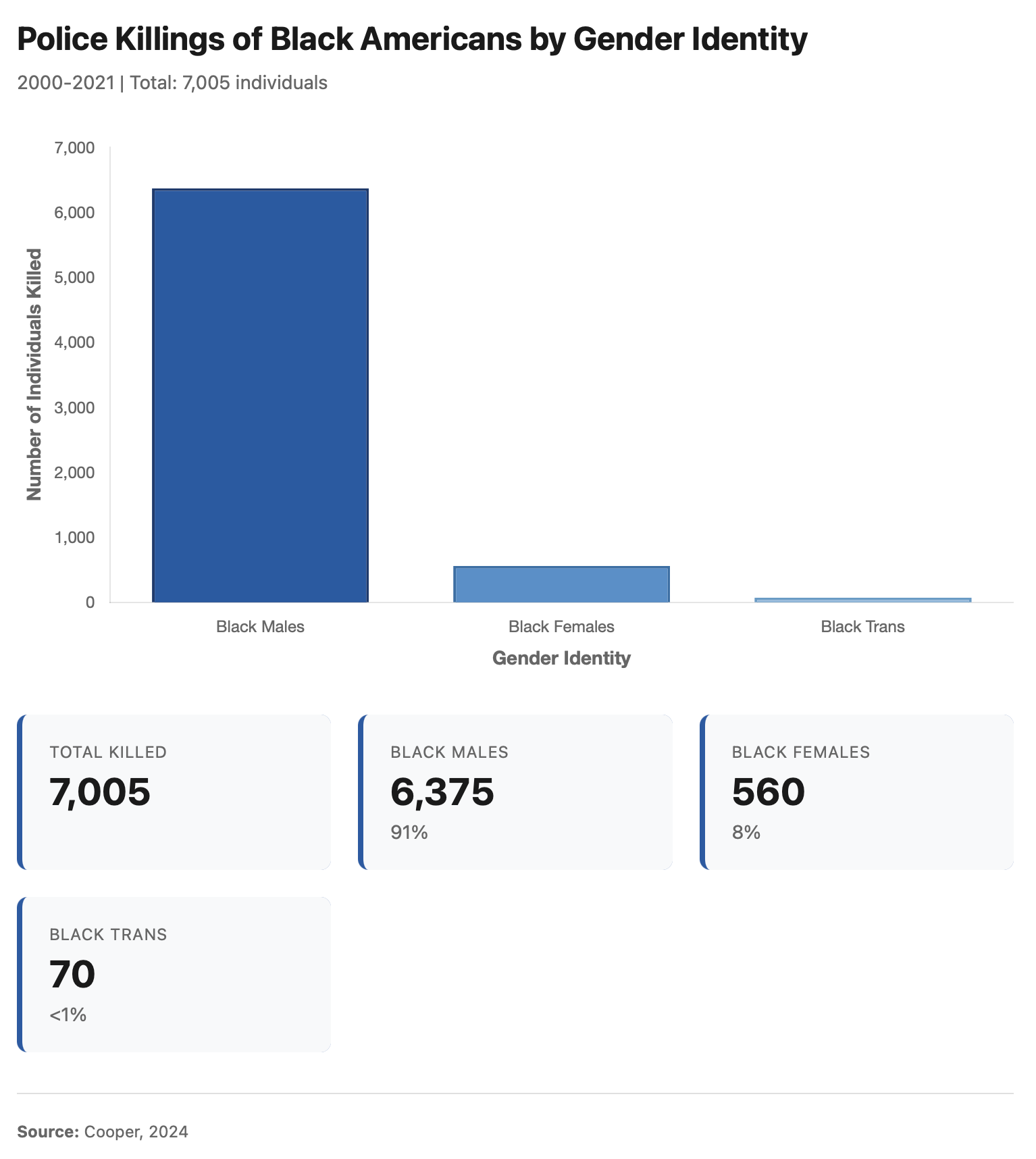
Intersectionality, however, lacks empirical grounding as a model of threat perception. Human cognition does not process danger through additive identity matrices, but through rapid categorical threat appraisal based on perceived risk (Cooper, 2024). Despite this, intersectionality has become a disciplinary ideology across academic, professional, and nonprofit domains, often discouraging empirical scrutiny and silencing community-based critiques. Many local activists experienced this framework not as inclusive, but as divisive and misaligned with the realities of police violence.
The dynamics observed in BLM are not unprecedented. Allen (1969) documented how corporate elites and philanthropic foundations, including the Ford Foundation, intentionally co-opted the Black Power movement by aligning with segments of the Black bourgeoisie to contain radical political thought. Rojas (2010) later showed how the Ford Foundation played a central role in institutionalizing Black Studies by prioritizing academic legitimacy and integrationist frameworks while systematically discouraging Black nationalist and explicitly radical orientations.
BLM represents a contemporary iteration of Plantation Politics. It illustrates how corporate and philanthropic elites, in collaboration with Black managerial actors, can absorb and neutralize political movements by reframing resistance through professionalized ideologies and nonprofit governance. Within this arrangement, suffering becomes currency, and legitimacy is earned not through confrontation with power but through alignment with it.
BLM was not a radical organization. It did not challenge existing hierarchies, nor did it pose a substantive threat to state or corporate power. Instead, it functioned as an assimilationist formation that enhanced hierarchy while producing no demonstrable structural change. What remains is not liberation, but accumulation; not collective power, but managerial legitimacy secured through Black male death.
References
Allen, R. L. (1969). Black awakening in capitalist America. Doubleday.
Cooper, S. (2020, October 6). Is Warren Buffett the wallet behind Black Lives Matter? Tablet Magazine. https://www.tabletmag.com/sections/news/articles/warren-buffett-black-lives-matter
Cooper, S. P. (2024, October 22). BLM collected over $90 million in donations. Where did it go?

Cooper, Y. (2024). Black men and racial trauma: Impacts, disparities, and interventions. Routledge.
Du Bois, W.E.B. Marxism and the negro problem. The Crisis; v.40, n.5 (May 1933): 103-104, 118.
Olorunnipa, T., & Burns, A. (2024, April 10). Cornel West names Melina Abdullah as his vice presidential running mate. Politico. https://www.politico.com/news/2024/04/10/cornel-west-black-lives-matter-activist-melina-abdullah-vice-president-00151525
Perry, I. (2021, May 24). Stop hustling black death. The Cut. https://www.thecut.com/article/samaria-rice-profile.html
Reed, T. F. (2015, August 22). Why liberals separate race from class. Jacobin. https://jacobin.com/2015/08/bernie-sanders-black-lives-matter-civil-rights-movement
Rojas, F. (2010). From black power to black studies: How a radical social movement became an academic discipline. JHU Press.
Savage, N. (2021, June 10). St. Louis murder of activist Seals unsolved five years later. Minnesota Spokesman-Recorder. https://spokesman-recorder.com/2021/06/09/st-louis-murder-of-activist-seals-unsolved-five-years-later
Stromberg, M. (2021, March 15). Boogie with Patrisse Cullors in a virtual electric slide. Hyperallergic. https://hyperallergic.com/patrisse-cullors-electric-slide-hammer-museum
Thorne, W. (2020, October 15). Black Lives Matter co-founder Patrisse Cullors signs overall deal with Warner Bros. Television group. Variety. https://variety.com/2020/tv/news/black-lives-matter-founder-patrisse-cullors-warner-bros-television-group-overall-deal-1234806076
This is a really good article!!! I enjoyed this read.
Thank you for your insights. Your work is always intriguing