

Black Celebrity Is Not Power. It Is Plantation Politics

The Decadent Veil and the Illusion of Black Power
“All skinfolk ain’t kinfolk.” — Zora Neale Hurston
Black celebrity is not evidence of Black power. It is evidence of how power manages dissent. What is presented as progress is often a managed spectacle, where a small number of Black individuals are elevated to obscure the conditions of the many. Visibility replaces transformation. Representation replaces accountability. This is not advancement. It is management.
Plantation politics does not disappear. It reorganizes. Plantation politics refers to a modern system of domination that mirrors the logic of the colonial plantation. In this system, Black people are strategically positioned to control, discipline, and silence other Black people on behalf of the white power structure (Cooper, 2024). Rewards, visibility, and institutional access are granted to those who align with dominant interests, while dissent is redirected, neutralized, or absorbed. In the 21st century, one of its most effective instruments is celebrity. In this context, celebrity functions as the cultural arm of plantation politics, shaping perception, regulating discourse, and narrowing how inequality is understood.
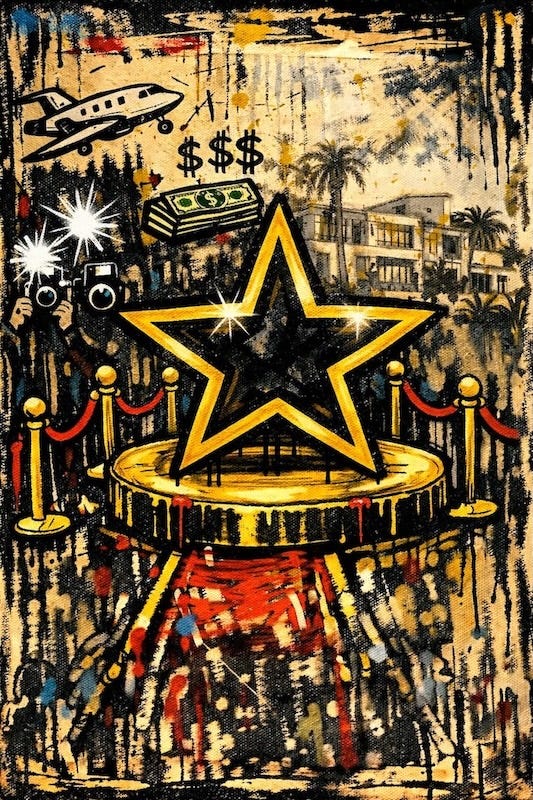
The Decadent Veil
The decadent veil describes how Black celebrity obscures the material reality of Black life. Moore (2014) defines the decadent veil as a masking process through which the visibility of wealthy Black celebrities distorts perceptions of Black economic conditions. A small number of highly visible individuals are positioned as evidence of collective progress, while structural inequality remains intact. This is not accidental. It is engineered. Media platforms circulate images of wealth through sports contracts, entertainment deals, and corporate partnerships. These images do not simply entertain. They reorganize perception. They create the impression that Black Americans are economically thriving despite persistent disparities in wealth, income, and ownership. The exceptional is made to represent the general, obscuring the conditions that make such exceptionality rare.
Celebrity, Activists, and the Managerial Class
Under plantation politics, celebrities, activists, and political figures function as intermediaries. They occupy positions within a managerial class that translates Black suffering into forms that are legible and acceptable to dominant institutions (Cooper, 2024).
As outlined in Plantation Politics – “Activists,” contemporary Black activism increasingly derives legitimacy from institutional recognition rather than community accountability. Visibility, funding, and access replace mass-based political organization.
Within this structure, suffering becomes currency, visibility becomes legitimacy, and legitimacy becomes access. What disappears is accountability. Celebrities are routinely positioned as spokespersons for the Black community regardless of their material distance from it. Structural problems are reframed as individual challenges. Systemic inequality is recoded as a matter of mindset, discipline, effort, entrepreneurship, or personal responsibility. These are not neutral messages. They are neoliberal and conservative myths laundered through celebrity visibility. This is not representation. It is management of perception and dissent.
The Political Economy of Illusion
The visibility of Black celebrity distorts the structure of economic power. Piketty (2014) shows that a large share of top incomes is concentrated among corporate executives and managerial elites, while athletes, entertainers, and artists represent only a small fraction of this class. This matters because Black celebrity wealth is made hypervisible, while the broader corporate class that controls ownership, capital, and institutional power remains comparatively invisible. The result is a racial illusion: Black wealth appears overrepresented in culture while remaining marginal in actual ownership and control. Black individuals generate enormous value in sports and entertainment, but ownership remains elsewhere. Professional sports franchises, media companies, and corporate institutions are overwhelmingly controlled by white elites. Celebrity does not redistribute power. It masks its concentration while rendering it less visible.
Psychological Conditioning and Aspirational Capture
The decadent veil reshapes how reality is perceived and how aspiration is structured. Young Black men are socialized to view sports and entertainment as primary routes out of poverty. These pathways are statistically rare but culturally normalized through constant exposure. At the same time, the saturation of exceptional success produces a false sense of collective advancement. It desensitizes audiences to widespread Black poverty, reduces attention to structural causes, and increases emphasis on individual achievement. This is not inspiration. It is aspirational capture. It redirects energy away from structural transformation and toward improbable individual outcomes.
Plantation Politics in the 21st Century
Plantation politics operates through incorporation. Black elites, celebrities, activists, politicians, academics, and professionals are integrated into dominant systems where they function as buffers between power and the Black masses. They absorb pressure, redirect dissent, and stabilize the structure (Cooper, 2024). Social dominance theory describes this as out-group favoritism, a process in which subordinated groups help maintain hierarchical systems that disadvantage them (Sidanius & Pratto, 1999). Within plantation politics, this alignment is incentivized and rewarded.
Conclusion
The function of Black celebrity is not visibility. It is distortion. It creates the illusion of progress while masking structural inequality. It elevates individuals while containing populations. It transforms systemic problems into personal narratives. The decadent veil ensures that Black deprivation remains politically invisible even as it is materially pervasive. Black celebrity, in this context, is not a reflection of liberation. It is a mechanism of control. Until that illusion is broken, plantation politics will continue to operate not in secrecy, but through spectacle, where visibility itself becomes a mechanism of control.
This essay is part of a broader series examining how plantation politics operates across domains, including activism, mental health, politics, culture, and knowledge production.
Be on the lookout for Plantation Politics in Academia: Knowledge, Legitimacy, and the Management of Truth.
References
Cooper, Y. (2024). Black men and racial trauma: Impacts, disparities, and interventions. Routledge.
Cooper, Y. (2026). Plantation politics – “Activists”: Elite capture, Black death, and the managerial class. Substack.
Moore, A. (2014, August 5). The decadent veil: Black America’s wealth illusion. HuffPost. http://www.huffpost.com/entry/the-decadent-veil-black-income-inequality_b_5646472
Piketty, T. (2014). Capital in the twenty-first century. Harvard University Press.
Sidanius, J., & Pratto, F. (1999). Social dominance: An intergroup theory of social hierarchy and oppression. Cambridge University Press.